pds · protección de superficies
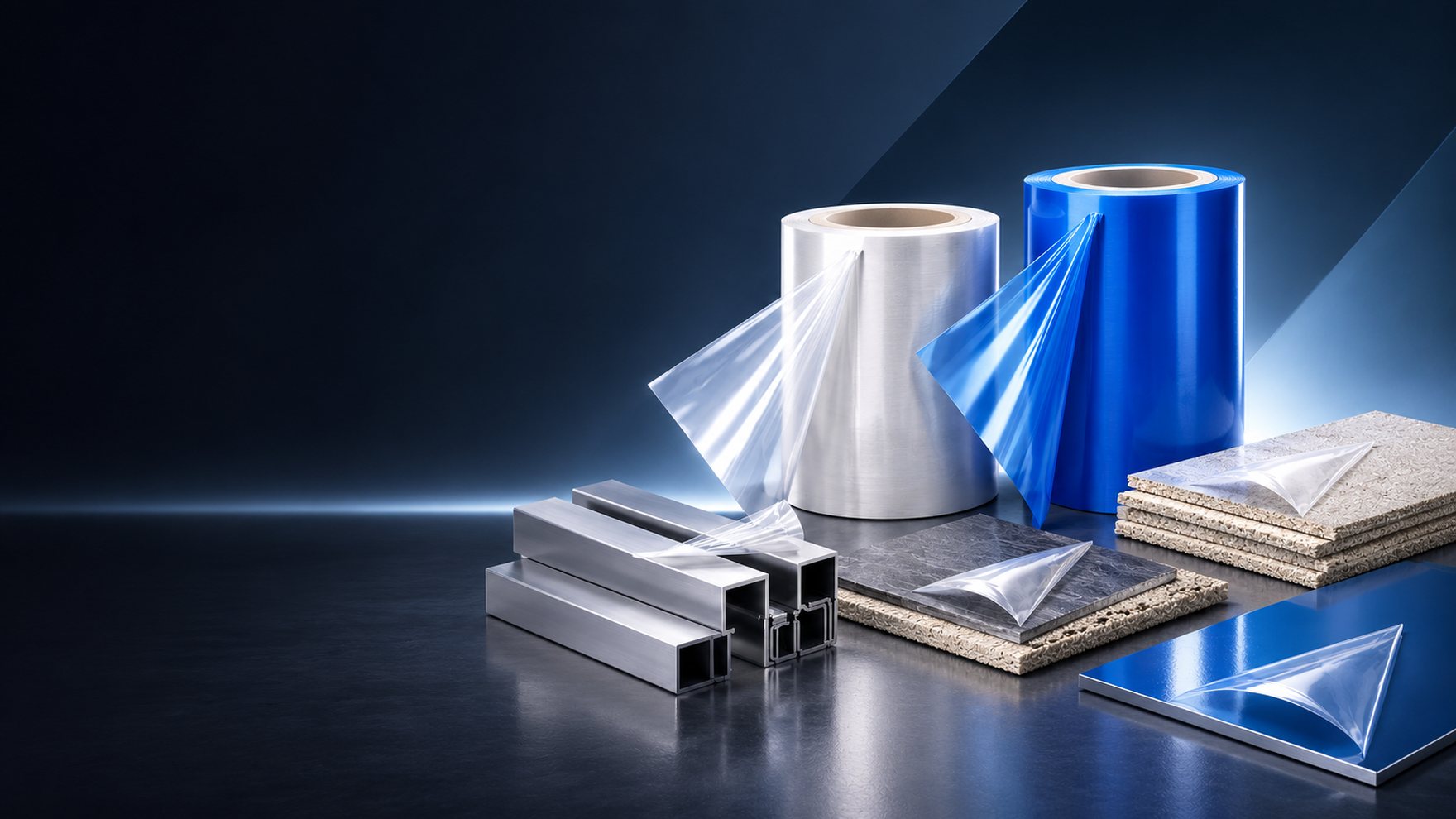
Rolls of clear and blue protective film beside aluminium profiles, steel sheets and boards with the film lifted at one corner

Why protect · Construction and Industry

The part does not arrive damaged. It gets damaged while it is made and installed.

The scratch on the profile happens at assembly. The chip in the glass, when the scaffolding goes up. The stain on the floor, when the plaster coat goes on. These are processes that have to happen, and every one of them passes over a finish that is already done.

The problem

Three ways to lose a finished surface.

Scratches and knocks on site

Glass, anodised aluminium, stainless steel and stone are installed early and handed over late. In that interval come the tools, the scaffolding, the rubble and the movement of site personnel.

Chemical contamination

Cement, plaster, paint, sealant and solvent landing on a finished surface. Removing them costs more than the material, and sometimes they do not come off: the part is replaced.

Delays from repair work

A damaged part is not simply replaced. It has to be coordinated with the supplier, the dispatch has to be waited for, the part refitted, and the handover date moves. The cost of the delay is rarely budgeted.

The cost

A claim is not paid for with the part.

It is paid for with six things. This is the list; you put in the values, with the prices from your own project. Add up the column and compare it against what it costs to cover the same batch with film.

What goes into the cost of a claim
ItemWhat it includesYour cost
The part Glass, profile, sheet or worktop that has to be bought again
The return freight Sending the damaged part back and dispatching the new one
The reinstallation Labour that had already been paid for once
The site visit Diagnosis, report and coordination with the supplier
The delay Days the handover slips, and what each one costs
The conversation What the claim weighs on the next purchase the client makes

Up to 10×

what it costs to deal with a claim, against what it costs to protect

A claim from the end customer is not paid for with the part. It is paid for with the part, the return freight, the reinstallation, the site visit, the delay in handover and the conversation with the customer. The film is the cheapest link in that whole chain.

Figure from Martínez Navas SAS

How we do it with you

An adviser from Martínez Navas takes a real batch from your project —a tower, an order, a dispatch—, puts the prices you work with into each line of that table and compares them against the cost of the film for that same batch. If the sum does not add up for you, we say so.

The savings

How much a company that protects saves.

Four cost areas that come down when the material arrives covered. These are the savings Martínez Navas reports across its own client base in Colombia.

80%

less material replacement

Protected glass, aluminium profile and stainless steel reach the site and are handed over in good condition, with no replacement for damage.

60%

less cleaning time at the end

The film acts as a barrier against cement, paint and dust. When it comes off the surface is clean, with no specialist cleaning process.

40%

lower warranty costs

Fewer warranty claims for damaged finishes, because the project is handed over with the material in good condition.

100%

covered from the machine to handover

The part leaves the line covered and is uncovered on handover day: the assembly, the handling and the dispatch all happen on the film, not on the finish.

Savings reported by Martínez Navas SAS across its client base in Colombia

Results

Two projects, before and after.

Case 01 · Apartment developer, Bogotá

The situation

On a 200-apartment project, 15% of the windows arrived damaged at final handover for lack of protection during the build.

With PDS film

With clear PDS film on all the glazing from installation onwards, the damage rate fell below 1% and more than $45 million COP in replacements was avoided.

Case 02 · Stainless steel company, Medellín

The situation

Industrial kitchen equipment was reaching the end customer with factory scratches, which meant constant returns and claims.

With PDS film

Applying the film from the production line onwards eliminated scratch claims and packing time fell by 30%.

Cases supplied by Martínez Navas SAS

The difference

Protecting and not protecting.

Without protection

  • The part is exposed from the day it is installed
  • The replacement was not in the budget
  • Specialist cleaning after the build
  • Warranty claims for damaged finishes
  • The handover slips

With PDS film

  • The part stays covered from installation through to handover
  • The cost of the film is budgeted once and is known
  • The film comes off and the surface is clean
  • The finish arrives as it left the factory
  • The handover date does not depend on a replacement

Who protects

Four businesses with the same problem.

Residential construction

Housing where the window units, the floors, the façade and the joinery have to reach the final buyer intact.

  • Window units
  • Stone or porcelain tile floors
  • Glass façade
  • Metal joinery

Commercial construction

Shopping centres, offices and hotels, where the finish is part of the value of the property and damage shows on the first day of operation.

  • Lobbies
  • Lifts
  • Façades
  • Bathrooms in natural stone

Manufacturing industry

Production lines where the part already carries added value and still has to go through assembly, storage and dispatch.

  • Machinery
  • White goods
  • Medical equipment
  • Assembly line

Logistics and transport

Anyone who moves flat glass, metal profile, panel and finished product, and answers for the state it arrives in.

  • Flat glass
  • Metal profile
  • Panel
  • Steel sheet

Recommendations sheet

Download our usage recommendations sheet

One page with what to keep in mind so the film performs: how to store it, how to prepare the surface, how to cut it and how to apply it with a laminator or by hand.

  • Storage: out of direct sun, no contact with the floor or the walls, no water, between 10 °C and 40 °C, maximum 5 boxes stacked and use within 5 months
  • Surface preparation: clean and dry, wiped down with a dry cloth to remove dust, grease and chemicals
  • Cuts to size, with an electric saw or through the Martínez Navas cutting service
  • Application with a laminator and application by hand, step by step
  • Sealing: the greater the pressure, the greater the adhesion, and always in the direction the roll unwinds
Download the sheet

PDF · 272 KB · Rev. 09-2026 · Martínez Navas SAS

Let us do the sums on a batch of yours.

Bring an order or a tower. We put your project's numbers into the table and compare them against the cost of the film.